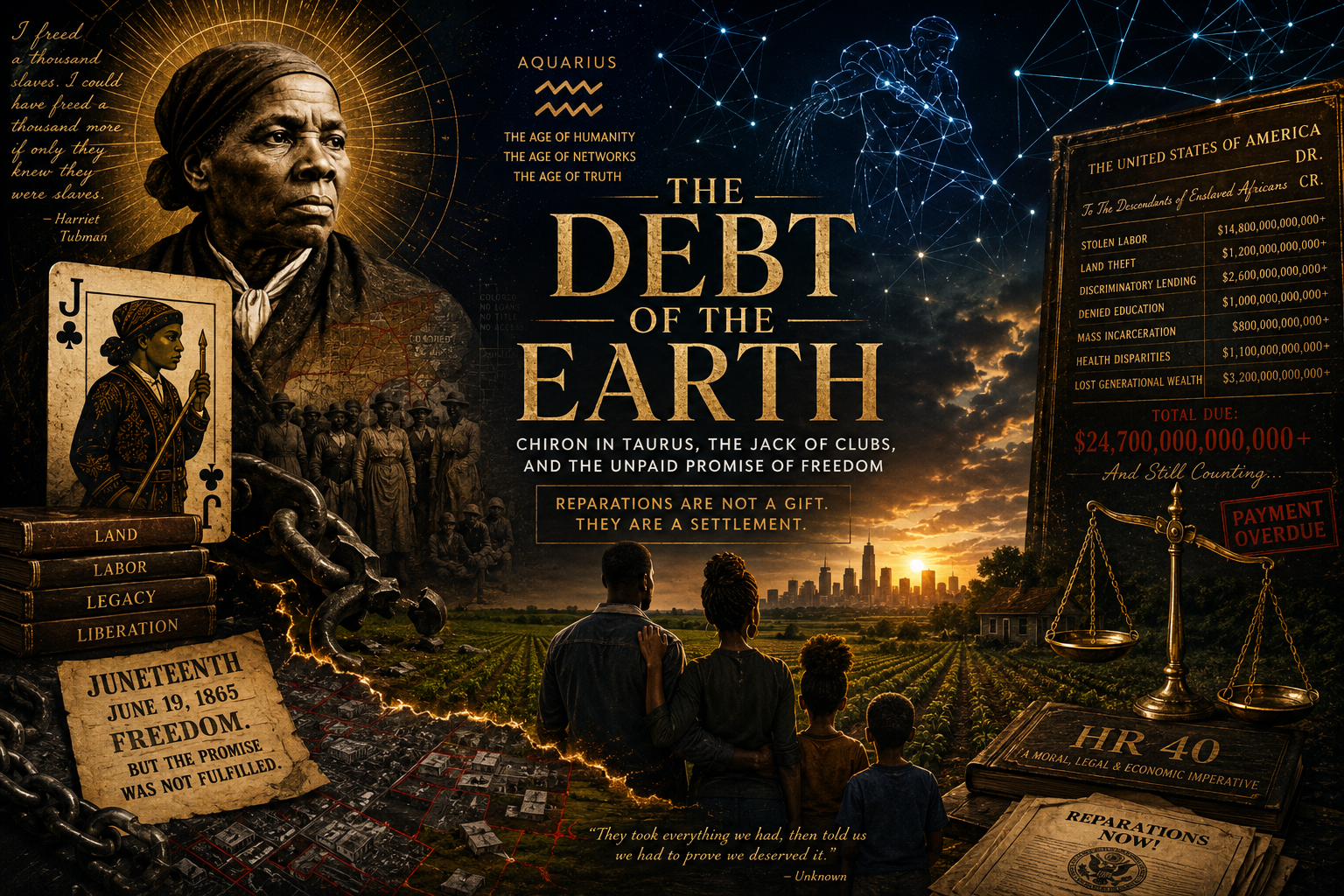

Every Juneteenth, America celebrates freedom.
But beneath the celebrations, the family reunions, the parades, and the declarations of liberation lies a far more uncomfortable question: What does freedom actually mean when it arrives without land, without capital, without security, and without the resources needed to sustain future generations?
The story of Juneteenth is often told as the final chapter of slavery. In reality, it may be better understood as the opening chapter of an entirely new struggle. The formerly enslaved were informed that they were free, but freedom did not arrive with economic restitution. It did not come with ownership of the land they had worked. It did not include access to the wealth their labor had helped create. And it did not bring any national commitment to repair the damage that centuries of bondage had produced.
Freedom came.
The resources necessary to sustain that freedom largely did not.
This contradiction sits at the very center of the reparations debate today.
A Question of Debt
For generations, discussions about reparations have been framed as moral arguments, political arguments, or historical arguments. But at its core, reparations is fundamentally an economic argument. It is a question of debt. It asks whether a society can acknowledge that wealth was extracted, opportunities were denied, and promises were broken, without also acknowledging the material consequences of those actions.
This is where the symbolism of Chiron in Taurus becomes surprisingly relevant.
Chiron in astrology represents a wound. Not an ordinary wound, but one that remains active long after the original injury occurred. Chiron reveals the places where pain becomes embedded into identity, culture, and institutions. It exposes problems that cannot be resolved simply by pretending they no longer exist.
Taurus governs a completely different realm. It rules land, agriculture, wealth, banking, ownership, inheritance, resources, food security, and value. Taurus concerns itself with the physical realities of existence. It asks the most practical questions imaginable: Who owns the land? Who controls the resources? Who receives access to capital? Who benefits from the value being created?
When Chiron moves through Taurus, societies are often forced to confront wounds tied directly to material security and economic worth. Questions surrounding ownership, wealth extraction, inheritance, and resource distribution move to the front of the conversation.
This is no coincidence. Chiron entered Taurus on Juneteenth 2026, and if history is any teacher, the years ahead will demand that we look honestly at exactly these questions.
What Happened the Last Time
The previous Chiron in Taurus transit ran from 1977 through 1983.
Most Americans remember that era through the lens of inflation, recession, and economic uncertainty. But beneath the headlines, something deeper was unfolding. It was a period during which many of the structural foundations of the modern racial wealth gap were reinforced through legislation, policy decisions, lending practices, and agricultural programs whose effects continue to shape Black economic life today.
From an astrological perspective, Chiron in Taurus exposed the wound.
From a historical perspective, it revealed how deeply embedded that wound had already become.
Harriet Tubman and the Jack of Clubs
Before exploring that economic history, it is worth pausing on another symbol.
Harriet Tubman was a Jack of Clubs.
Within the ancient science of Cardology, the Jack of Clubs represents communication, innovation, education, networking, and the transmission of ideas. Jack of Clubs individuals act as bridges between worlds. They carry knowledge that helps humanity evolve beyond its current limitations.
Most people remember Harriet Tubman as the conductor of the Underground Railroad. What is often overlooked is that her greatest power was not physical strength. It was information. Tubman understood routes, networks, timing, geography, human psychology, and strategy. She moved intelligence through hostile territory. She organized systems of communication in environments where a single miscalculation could mean death.
She was not merely transporting people. She was transporting possibility.
This is one of the highest expressions of the Jack of Clubs archetype, and there is a deeper layer of Cardology that makes this even more striking.
In the ancient science of cards, every birth card carries a Neptune card, representing the realm of dreams, spiritual longing, and the soul's deepest calling. The Jack of Clubs carries the Four of Diamonds in Neptune. The Four of Diamonds is the card of material security, stable resources, and financial foundation.
What this means is profound. When a Jack of Clubs follows their dreams, their ideals, their highest vision for humanity, material security follows. Not as a side effect. As a direct result. The universe is structured so that the Jack of Clubs receives what they need when they pursue what they believe in. It functions like the repayment of a long-existing debt. The spiritual and the material are not in opposition for this archetype. They are the same path.
Harriet Tubman did not pursue liberation for personal gain. She followed a vision that was larger than herself. And the Cardology of her birth card suggests that this is precisely how the Jack of Clubs is designed to operate. The dream leads to the security. The calling produces the foundation.
It is difficult not to see this symbolism reflected in the reparations movement itself. The pursuit of a long-deferred dream, the recovery of what was always owed, the idea that following the call for justice leads inevitably toward material restoration. This is Jack of Clubs energy at its most cosmic.
It appears whenever humanity is trying to communicate itself into a new reality. Throughout history, this energy has shown up through educators, journalists, inventors, revolutionaries, artists, and cultural innovators. The Jack of Clubs understands that before systems can change, consciousness must change. Before freedom can be experienced, it must first be imagined.
This is why it is so striking that one of the most powerful cultural movements in modern history was born during the previous Chiron in Taurus transit.
Hip-Hop emerged from the South Bronx in this very era.
While politicians debated economic policy and institutions reshaped access to capital, young Black Americans were creating a new language. Hip-Hop became a vehicle for documenting conditions that official narratives consistently ignored. It transformed local experiences into global conversations. It crossed racial, national, and economic boundaries with remarkable speed.
In many ways, Hip-Hop functioned as a modern Jack of Clubs transmission. The messenger arrived precisely when the wound was being exposed.
The Battle for Capital
One of the most significant economic developments of that Chiron in Taurus period was the passage of the Community Reinvestment Act of 1977.
To understand why this matters, you need to understand redlining.
For decades, banks and lending institutions had systematically denied mortgages and credit to Black neighborhoods. Entire communities were designated as financially undesirable, regardless of the qualifications of the individuals living within them. This practice prevented millions of Black families from participating in one of the most important engines of wealth creation in American history: homeownership.
The Community Reinvestment Act was introduced as a corrective measure. Congress sought to compel banks to serve all communities, including low-income and historically underserved neighborhoods. On paper, this represented a meaningful step forward.
Yet the legislation had a critical limitation.
It addressed geography more directly than it addressed race. By focusing on income and neighborhood classifications rather than explicitly targeting racial discrimination, the law left room for institutions to comply with the letter of the legislation while avoiding the deeper realities that had produced inequality in the first place.
The result was a familiar pattern in American history. A wound was acknowledged without being fully treated.
Communities gained greater access to credit, but access to credit is not the same thing as access to wealth. Credit can create opportunity, but it can also create vulnerability when it is not paired with equitable investment, genuine ownership, and long-term asset building.
The deeper wound remained intact.
The Loss of the Earth
If banking represents one dimension of Taurus, land represents the other.
Throughout human history, land has been one of the primary ways wealth is accumulated and transferred between generations. Land provides security. It provides leverage. It provides inheritance. For Black Americans, land ownership has always been intimately connected to the unfinished promises of emancipation.
This is why the agricultural crisis of the late 1970s and early 1980s carries such weight.
As inflation surged and interest rates climbed to historic levels, farmers across the country faced extraordinary economic pressure. The Federal Reserve's aggressive response to inflation made borrowing costs nearly impossible for many operations to absorb. Farms that depended on credit suddenly found themselves fighting for survival.
Black farmers entered this crisis from an already deeply disadvantaged position.
For decades, they had reported discriminatory treatment by federal agencies: unequal access to loans, deliberately delayed approvals, and exclusion from agricultural assistance programs. When economic conditions deteriorated, those pre-existing disparities became catastrophic.
Many Black farmers were denied the emergency support needed to weather the crisis. Operating loans were withheld. Disaster relief was delayed or denied altogether. The consequences were devastating. Families lost farms that had been held for generations. Land that had survived Reconstruction, Jim Crow, and countless other assaults was lost within a relatively short window of time.
Every acre lost represented wealth that could no longer be passed to children and grandchildren.
When people discuss reparations, they often focus exclusively on slavery. But wealth extraction continued long after emancipation. The destruction of Black land ownership during the late twentieth century is one of the clearest examples of this ongoing reality.
The wound was not ancient history. It was happening in real time.
The Politics of Survival
Taurus governs more than money and land. It also governs food, nourishment, physical well-being, and the basic resources necessary for survival. Economic security, at its most fundamental level, begins with meeting daily needs. A society reveals its values through how well it ensures its people can do that.
This brings us to the Omnibus Budget Reconciliation Act of 1981.
Passed during the Reagan administration, this legislation dramatically reshaped the American social safety net. Funding was cut across a wide range of social programs. Access to food assistance became more restricted. Eligibility requirements tightened across multiple forms of public support. The legislation was presented as a necessary correction to government spending, but its impact fell most heavily on the nation's most economically vulnerable populations.
The cultural narrative accompanying these changes is equally significant. During this same period, the image of the "Welfare Queen" became deeply embedded in American political discourse. This stereotype suggested that poverty was the result of personal irresponsibility rather than structural conditions. It redirected attention away from historical inequalities and shifted the blame onto the very individuals most damaged by those inequalities.
For Black communities, this narrative carried a particular sting. It transformed the descendants of people whose uncompensated labor had helped build enormous portions of the nation's wealth into symbols of economic burden.
From a reparations perspective, this represents a profound inversion of reality.
The question should never have been whether Black Americans were receiving too much support. The question should have been whether the nation had ever adequately addressed the economic consequences of centuries of uncompensated labor, discriminatory policies, land theft, exclusion from wealth-building programs, and systematic denial of opportunity.
Instead of discussing the debt owed to Black communities, the national conversation shifted toward the alleged cost of supporting them.
This is one of the defining wounds of Chiron in Taurus.
The people carrying the debt are portrayed as the debtors.
Chiron's Medicine: Queen Mother Moore and the Birth of Modern Reparations
Chiron never reveals a wound without simultaneously pointing toward the possibility of healing.
One of the most remarkable developments of the 1977 to 1983 period was not legislative at all. It was intellectual and organizational.
While wealth extraction was accelerating, a generation of activists was building a framework for economic repair.
At the center of that work stood Queen Mother Audley Moore.
Long before reparations entered mainstream political conversation, Moore was traveling the country educating Black communities about the economic dimensions of slavery and its long aftermath. She argued that emancipation had never been completed because the material promises associated with freedom had never been fulfilled. Political rights had expanded, but economic justice remained almost entirely unaddressed.
Her work during this period helped cultivate the next generation of reparations advocates. The legal arguments, economic analyses, and organizational structures being developed during these very years would later seed the creation of NCOBRA, the National Coalition of Blacks for Reparations in America, which formally launched in 1987. Chiron had already moved on, but the wound it exposed had done its work. The groundwork laid under Chiron in Taurus helped make NCOBRA possible.
This is precisely how Chiron operates.
The wound becomes the source of wisdom. The injury becomes the catalyst for organization. The pain becomes the blueprint for healing.
Rather than accepting economic losses as isolated incidents, activists began documenting patterns. They connected slavery to Reconstruction. Reconstruction to Jim Crow. Jim Crow to discriminatory housing policies. Housing discrimination to the racial wealth gap. Agricultural discrimination to land loss. Social policy cuts to compounding economic insecurity.
What emerged was not merely a protest movement. It was a ledger. A systematic effort to account for what had been taken.
This distinction matters because reparations is widely misunderstood. Many assume it is about guilt. Others assume it is about punishment. Historically, reparations has always been about accounting. An attempt to calculate losses. An attempt to quantify harm. An attempt to repair damage that can be documented through policy, law, and economic analysis.
In many ways, the reparations movement itself is the medicine that grew from the Chiron wound.
Pluto in Aquarius and the Return of the Jack of Clubs
If Chiron in Taurus is exposing the wound again, another major astrological development helps explain why reparations is re-entering public discourse with such force.
Pluto is now in Aquarius.
Historically, Pluto's movement through a sign corresponds with deep structural transformation. Pluto does not merely reform systems. It exposes underlying power dynamics and forces societies to confront truths that have been buried beneath the surface.
Aquarius governs humanity, collective progress, networks, technology, social movements, and the distribution of knowledge. It is concerned with how societies organize themselves and how power flows among the collective.
The symbolism is striking.
The Jack of Clubs is often described as one of the great humanitarian archetypes of the Aquarian Age. It represents the spread of ideas across networks. It governs communication that transcends borders. It seeks to connect humanity through shared knowledge.
Harriet Tubman embodied this principle in the nineteenth century.
Hip-Hop embodied it in the twentieth.
Digital networks are embodying it in the twenty-first.
For the first time in history, information about wealth disparities, discriminatory policies, land theft, and the full scope of what was lost can be distributed globally in real time. Research that once remained confined to academic circles now circulates through podcasts, documentaries, social media platforms, and independent media networks. Aquarius dissolves information monopolies. People no longer need permission from traditional institutions to access historical records or challenge official narratives.
This matters enormously because reparations has always faced an information problem.
For decades, many Americans simply did not understand the scale of wealth extraction that continued after slavery ended. They were taught to view economic inequality as a natural outcome rather than the product of specific decisions, specific policies, and specific choices made by specific people in power.
Pluto in Aquarius is changing that.
Hidden records are becoming visible. Forgotten histories are returning to public awareness. Old assumptions are being subjected to collective scrutiny.
This does not guarantee that reparations legislation will pass. Astrology cannot determine the outcome of legislation. But Pluto in Aquarius does suggest that issues involving collective fairness, systemic inequality, and historical accountability will become increasingly difficult for societies to avoid.
The conversation around reparations is no longer happening only at the margins. Municipal governments are studying the issue. State-level commissions have formed. Academic research continues to expand. Public awareness is growing in ways that would have seemed unlikely just a decade ago.
What once seemed politically impossible no longer appears unimaginable.
And that is often exactly how major social transformations begin.
First they become discussable.
Then they become debatable.
Then they become inevitable.
Closing the Ledger
At its heart, the reparations conversation is not simply about the past.
It is about value.
Taurus asks what something is worth. What is labor worth? What is stolen land worth? What is a century of denied opportunity worth? What is a community's contribution to a nation's wealth actually worth?
These are difficult questions because they force a society to move beyond symbolism and into material reality. A Taurean wound cannot be healed through words alone. It requires tangible action.
The history of Black America demonstrates that wealth extraction did not end with slavery. It continued through discriminatory lending, unequal access to federal programs, land dispossession, exclusion from wealth-building opportunities, and policies whose effects remain clearly visible today.
The period from 1977 to 1983 represents one important chapter of that longer story. During those years, many of the economic disparities defining the modern racial wealth gap became further entrenched. Yet it was also during those same years that the intellectual foundations of the modern reparations movement were strengthened.
The wound and the medicine emerged together.
Perhaps that is the ultimate teaching of Chiron in Taurus.
Healing begins when a society becomes willing to examine its economic history honestly. It continues when that history is translated into meaningful action. And it is completed only when the ledger is finally balanced.
Harriet Tubman, the Jack of Clubs, understood that freedom was never simply the absence of chains. Freedom required movement, opportunity, security, and the ability to build a future.
More than a century later, the same question remains before us.
What does freedom mean when the debt has never been paid?
As Chiron moves through Taurus and Pluto reshapes the information landscape of the Aquarian Age, that question will become increasingly difficult to avoid.
The wound has been documented.
The ledger has been assembled.
The question now is whether the nation is finally prepared to settle the account